
Search and hit enter


job description:
Autonomous platform for field crops phenotyping
We are looking for highly motivated MScs, PhDs and post-docs for a large interdisciplinary project that involves the development of an autonomous platform for field crops phenotyping.
The project is conducted within the recently-established Israeli Center for Digital Agriculture that brings together researchers from the Technion, Hebrew University of Jerusalem and Ben Gurion University.
A wide range of topics requiring different skills at levels ranging from B.Sc. to post-doc are available, such as:
Applicants should have good programming skills.
Previous experience with Linux and ROS2 is an advantage for some of the projects.
Department Web Site:
job description:
מנהל/ת מעבדת מחקר חישובית בהידרו-גיאופיזיקה – תפקיד מוביל למהנדס/ת או גיאופיזיקאי/ת | אפשרות להשלמת מאסטר/דוקטורט במקביל למשרה
פרטים מלאים על המשרה ניתן לקרוא בקישור המופיע מטה:
דרוש/ה מנהל/ת מעבדת מחקר חדש/ה למודלים חישוביים בהידרו-גיאופיזיקה
job description:
Muscle and nuclear mechanobiology
The newly established Amiad-Pavlov lab is seeking highly motivated MSc and PhD students for an interdisciplinary research project spanning cardiac muscle physiology, biophysics and cell biology. We use advanced imaging approach to study how mechanical signals dynamically regulate nuclear structure and function in the highly contractile muscle.
Department Web Site:
job description:
Modeling Crustal Geothermal Flow and Water–Rock Interactions – Geological (White) Hydrogen and Hypogene Cave Systems
Three Funded M.Sc./Ph.D. or Postdoctoral Positions (Israel):
We seek motivated and curious M.Sc., Ph.D., or Postdoctoral candidates to join funded research projects focused on modeling crustal geothermal flow and water–rock interactions, with applications to geological (“white”) hydrogen systems and hypogene cave formation.
The research will be conducted under the supervision of Dr. Roi Roded (Tel-Hai, University on the Rise) and Prof. Einat Aharonov and Prof. Amos Frumkin (The Hebrew University of Jerusalem), in collaboration with additional researchers from Israel and abroad.
To apply, please send a CV and a short letter describing your relevant background and scientific interests to roi.roded@mail.huji.ac.il.
Department Web Site:
More information about the positions can be found in the link below:
job description:
We are currently recruiting master and doctorate students for research on the design of selective membranes for desalination, water treatment, and resource recovery
Department Web Site:
job description:
We’re combining experimental and computational biology to study the interactions between the microbiome and host physiology, immune system, inflammatory bowel disease, cancer, and more.
Department Web Site:
job description:
A post-doctoral or PhD position in Gene Expression & RNA Biology
A postdoctoral or PhD position is available in the laboratory of Prof. Mordechai (Motti) Choder at the Faculty of Medicine. The lab uses yeast as a powerful model system to uncover fundamental principles of intracellular communication that integrate all stages of gene expression— from transcription to mRNA fate— into a unified regulatory system.
The specific project focuses on uncovering the molecular mechanisms by which mRNA degradation factors function in transcription activation (yes—this is not a mistake). The work will explore how these factors operate within phase-separated transcriptional condensates, employing state-of-the-art high-throughput and systems-level approaches.
This research addresses central questions in gene regulation and is highly relevant to cellular adaptation to environmental changes, including stress responses and dynamic signaling states.
The position is ideal for candidates interested in:
• RNA biology and gene expression regulation
• Transcription–mRNA decay crosstalk
• Phase separation and biomolecular condensates
• Cutting-edge genomic and proteomic methodologies
Selected publications of the group that are relevant to the project:
• Cell doi: 10.1016/j.cell.2010.10.033
• Cell doi: 10.1016/j.cell.2011.12.005
• Cell doi: 10.1016/j.cell.2013.05.012
• Nat comm doi: 10.1038/s41467-022-34417-z
• Nat comm doi: 10.1038/s41467-019-09199-6
• eLife doi.org/10.7554/eLife.90766.1
Department Web Site:
job description:
Brain mechanisms of navigation
Our lab studies the cognitive processes of spatial memory and navigation, in birds.
We use the most advanced techniques for measuring the activity of ensembles of neurons in awake behaving and flying birds.
The research is interdisciplinary, combining cellular biology, ethology, evolution, data processing and electrophysiology.
Department Web Site:
job description:
Learning from learning systems
Looking for MSc, PhD, postdocs.
Evolution is the process by which organisms acquire functionality. Understanding evolution does not mean we understand how specific organisms operate – that is what biology does.
Likewise, we know how to train artificial neural networks to do things. But we don’t understand how they work after training.
My lab advances the “biology” of artificial networks.
Come and develop tools to reverse engineer trained networks, and to apply these tools back in the study of the biological brain.
Department Web Site:
job description:
Live Tracing stem cell function and Their regulation in Health & Disease
Join Us in Cutting-Edge Stem Cell Research!
Stem cells hold the key to tissue renewal and repair, yet fundamental questions remain: How are they identified and regulated? What drives their fate decisions? And how can we harness their regenerative power when natural healing fails?
Our lab tackles these challenges using the cornea and skin as model systems. We explore how stem cells interact with their niche, how genetic and epigenetic programs control their identity, and how tissues respond to stem cell loss. Combining molecular biology, advanced imaging, animal models, and human tissue culture, we aim to uncover principles of regeneration and develop new therapeutic strategies.
If you’re passionate about stem cell biology, stem cell-based bioengineering, and regenerative medicine—this is your opportunity!
Be part of research that transforms science and healthcare.
Department Web Site:
job description:
Ultrafast Laser Spectroscope
We Use sequences of femtosecond (10^-15 s) laser pulses to study molecular dynamics in solutions and in confined environments created by nanostructures.
Department Web Site:
https://chemistry.technion.ac.il/en/team/lev-chuntonov/
job description:
Flow Physics Lab
The Flow Physics Lab focuses on theoretical and computational investigations of flow physics, with specific emphasis on instability and transition to turbulence. The common thread guiding our research is using a minimal number of elements to describe physical phenomena. Therefore, canonical settings, where effects of various parameters can be isolated, are often analyzed. Investigations of flow physics provide us with guidelines for controlling the flow and avoiding undesirable phenomena (e.g. stall, noise and vibrations), leading to safer, quieter and more efficient aerial vehicles with lower drag and fuel consumption.
Department Web Site:
job description:
Coordination and Control of Multi-agent systems
The Cooperative Networks and Controls Lab (ConNeCt) is seeking motivated students to pursue a MSc, PhD, or Post-Doc.
We are looking for students with a broad interest in multi-agent and network control theory. Problems we consider include, but are not limited to control and coordination of multi-robot systems design of robust and resilient network systems networked event-triggered control problems graph-theoretic methods for control of multi-agent systems.
The successful candidate should have a strong background in control theory and mathematics.
Interested candidates are invited to send a copy of their CV, academic transcript, and brief research statement to Prof. Daniel Zelazo
Department Web Site:
job description:
About:
Join the Water Systems Lab to ensure safe reclaimed-water use for intermittent irrigation under dynamic conditions. Work spans microbial/AMR dynamics, disinfection & biofilm control, and a digital twin for system optimization using EPyT-C/EPANET.
Start: Jan 1, 2026
Support: BMBF–MOST
Responsibilities:
• Model multi-species transport, regrowth, and ARB/ARG fate.
• Fuse pilot data into probabilistic/ML frameworks; design control & disinfection strategies.
• Collaborate with TUM partners; publish results.
Qualifications:
• PhD track: M.Sc. in a relevant field.
• Postdoc: PhD in Environmental/Civil/Chemical Engineering (or related).
• Strength in water-quality modeling/microbiology/AI; Python tools (EPyT-C, WNTR, EPANET-MSX) a plus.
• Strong writing and teamwork.
Apply:
Send CV + cover letter to ostfeld@tx.technion.ac.il
Department Web Site:
job description:
Many important mobility questions cannot be answered without careful data collection and controlled experiments. This project develops a privacy-preserving platform that supports safe mobility data collection and, later, controlled studies of information interventions.
What you might work on:
Depending on your interests, you may contribute to privacy-aware data pipelines, measurement validation, and utility benchmarking (how privacy choices affect what analyses remain possible). The platform is modular, so contributions can be well-scoped and meaningful even without building a full-stack app.
Why it matters:
Infrastructure that is privacy-respecting and scientifically validated can enable research that is both ethically sound and practically useful. It also creates opportunities for collaboration with cities and mobility organizations.
Who we are looking for:
Students interested in applied research engineering at the boundary of mobility, data, and privacy. Comfortable coding helps, but the key is careful thinking, testing, and documentation—making tools that others can trust.
Department Web Site:
job description:
When many travelers respond to the same guidance (e.g., route recommendations), the outcome is not simply everyone gets faster routes. Their responses interact through congestion in mobility systems. This project develops system-level models and algorithms for information design: how agencies or platforms should structure guidance so that the whole network performs better, not just individual trips.
What you might work on:
You will build equilibrium models that represent different levels of responsiveness to guidance. You will then study how changing the information policy (e.g., what is communicated, how precise it is, and how it is delivered) affects congestion outcomes, reliability, and distributional impacts across travelers. The project gradually moves toward designing information policies using optimization methods and testing them on real-size networks.
Why it matters:
As platforms become central in shaping mobility, we need scientific tools to prevent guidance from causing harmful feedback loops, instability, or inequities—and to design guidance that is robust and beneficial.
Who we are looking for:
Students who like systems thinking, networks, game theory, and optimization. A good fit if you enjoy turning a complex socio-technical problem into a clear model, and then building algorithms and numerical experiments to answer it
Department Web Site:
job description:
Mobility data is powerful, but it is also sensitive. Cities and platforms increasingly want to learn how people travel while protecting privacy. This project will develop methods that allow us to obtain meaningful behavioral insights via structural spatiotemporal choice models, meanwhile ensuring privacies are protected.
What you might work on:
You will build and test models that connect mobility decisions (such as route, mode, or timing) to context (time, network conditions, and constraints). You will then study how privacy-preserving data changes what can be reliably learned, and develop estimation strategies that remain stable and interpretable under these constraints.
Why it matters:
Mobility data was historically difficult to collect at scale, and privacy has been one of the main barriers. By developing privacy-preserving modeling and inference methods, we aim to extract meaningful behavioral insights that can inform better services and policies while protecting individuals. This helps move transportation planning into a true large-data regime, where more advanced and data-hungry methods can be applied responsibly.
Who we are looking for:
Students who enjoy a mix of modeling and data work. A strong fit if you like statistics, discrete choice, optimization, and reproducible computational experiments. Programming experience (Python/R) is helpful, but motivation to learn matters most.
Department Web Site:
https://moca-technion.github.io
job description:
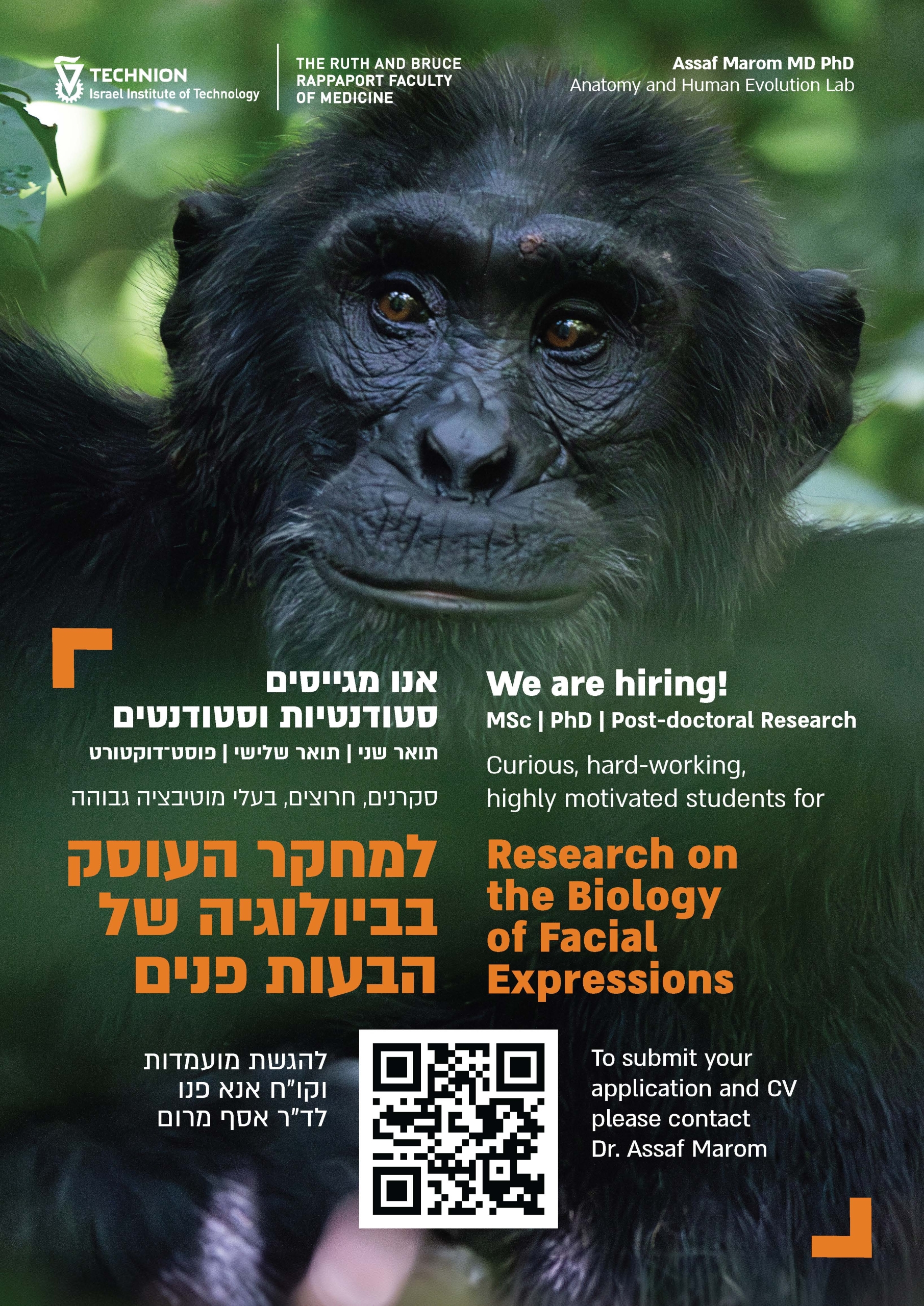
Description of the laboratory:
Research on Biology of Facial expressions
Proposed position:
MS.c, Ph.D, Post-doctoral Researchers
Department Web Site: